


Problem-solving skills are among the most valuable abilities children can develop during their early years. These skills help kids navigate challenges, think critically, and approach obstacles with confidence and creativity. The good news? Learning problem-solving doesn't have to feel like schoolwork. The right toys for problem solving transform learning into engaging play experiences that naturally build cognitive abilities while keeping children entertained for hours. From toddlers exploring shape sorters to older children tackling complex building challenges, problem-solving toys create opportunities for growth at every developmental stage.
Why Problem-Solving Skills Matter in Early Childhood
Critical thinking abilities form the foundation for academic success and life skills that extend far beyond the classroom. When children engage with toys for problem solving, they develop mental flexibility that helps them adapt to new situations throughout their lives.
Research shows that educational toys can significantly improve a child's problem-solving and critical thinking skills when chosen thoughtfully. These toys encourage children to experiment, make mistakes, and discover solutions independently.
Cognitive Benefits of Problem-Solving Play
Children who regularly engage with challenging toys develop stronger neural pathways in areas related to reasoning and spatial awareness. This brain development happens naturally through play.
- Enhanced memory retention through trial-and-error learning
- Improved focus and concentration during extended play sessions
- Better spatial reasoning when manipulating objects and understanding relationships
- Stronger logical thinking as children predict outcomes and test hypotheses
- Increased perseverance when facing challenging tasks
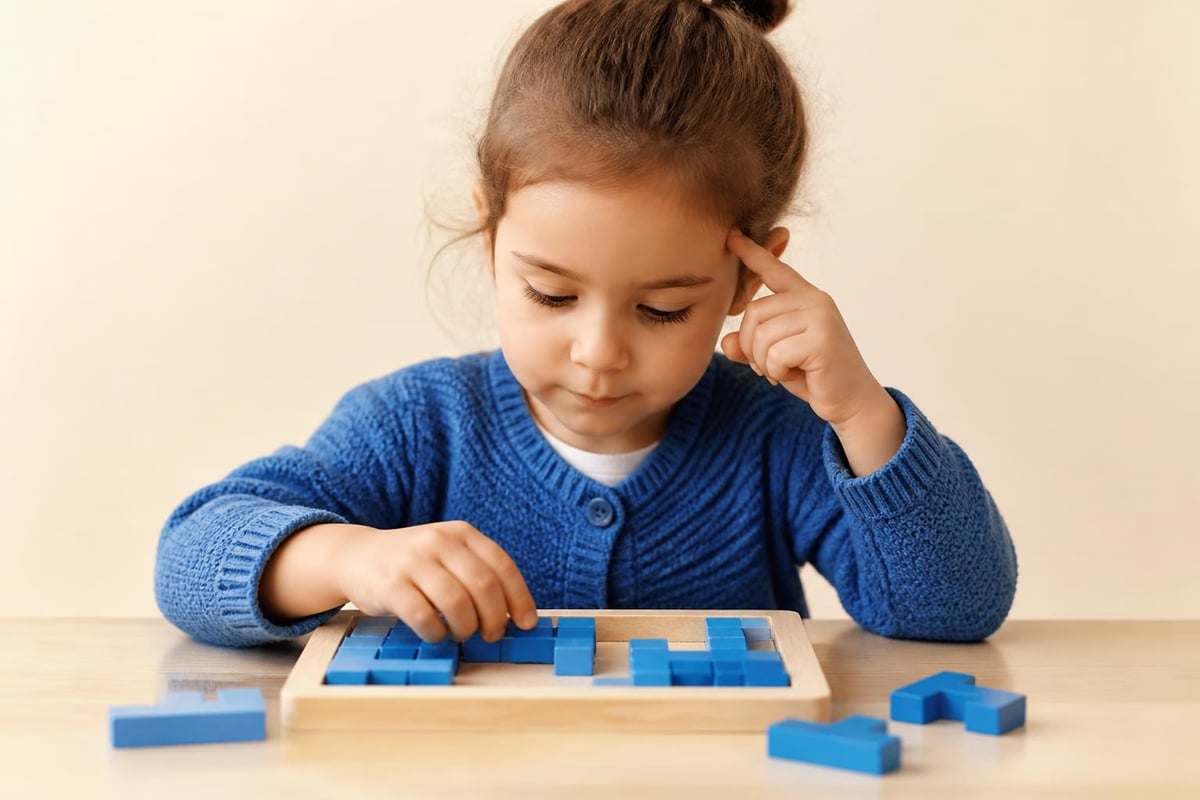
Young children learn best through hands-on experiences that engage multiple senses simultaneously. Toys for problem solving provide exactly this type of multi-sensory learning environment.
Age-Appropriate Toys for Problem Solving by Development Stage
Selecting the right complexity level ensures children feel challenged without becoming frustrated. Different ages require different approaches to problem-solving play.
Toddlers (Ages 1-3): Foundation Building
Toddlers need simple cause-and-effect toys that introduce basic problem-solving concepts. At this stage, success builds confidence and motivates further exploration.
Shape sorters remain classic choices because they teach spatial awareness while developing fine motor skills. Children learn to match shapes, rotate objects, and understand how different forms fit together.
Stacking toys and nesting cups introduce size relationships and sequencing. These seemingly simple toys actually teach complex mathematical concepts like ordering and comparison.
| Toy Type | Skills Developed | Recommended Age |
|---|---|---|
| Shape Sorters | Spatial reasoning, hand-eye coordination | 12-24 months |
| Stacking Rings | Size differentiation, sequencing | 18-30 months |
| Simple Puzzles (2-4 pieces) | Visual recognition, problem-solving | 24-36 months |
| Nesting Blocks | Understanding volume, spatial relations | 18-36 months |
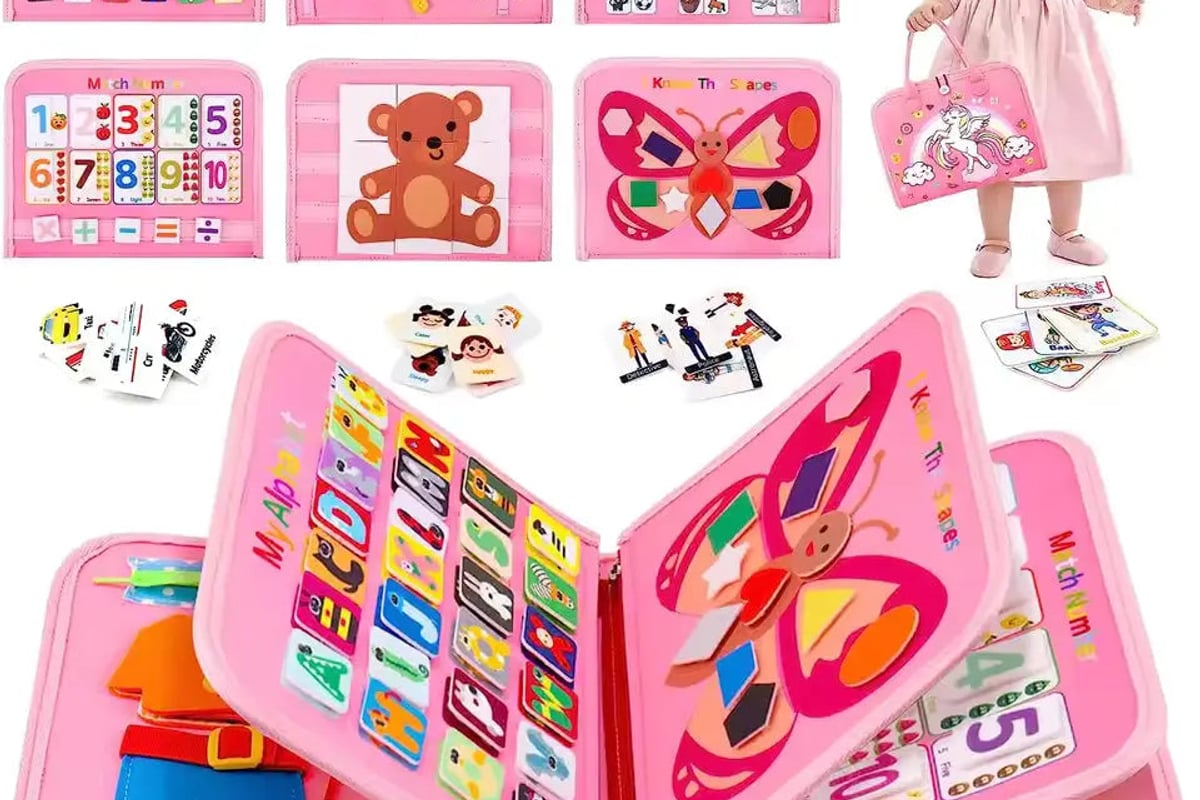
Busy boards offer multiple problem-solving activities in one engaging package. The Montessori Busy Board – KIDZEEHUB features switches, buttons, zippers, and buckles that challenge toddlers to figure out different mechanisms while building essential life skills and fine motor control.
Preschoolers (Ages 3-5): Expanding Complexity
Preschoolers can handle more complex challenges that require multiple steps to solve. This age group benefits from toys that combine creativity with logical thinking.
Building blocks and construction sets allow children to plan, execute, and modify their creations. These open-ended toys for problem solving encourage experimentation without predetermined right answers.
Educational toys for problem-solving toddlers include wooden blocks, magnetic tiles, and simple mechanical toys that teach cause and effect through engaging play.
- Jigsaw puzzles with 12-24 pieces develop visual-spatial skills and patience
- Magnetic building tiles teach geometry and structural stability
- Pattern blocks introduce mathematical thinking and symmetry
- Simple board games teach rule-following and strategic thinking
- Lacing and threading toys improve fine motor skills and sequencing
School-Age Children (Ages 6-8): Advanced Challenges
Older children need toys that present genuine challenges requiring sustained effort and strategic planning. These experiences build resilience and critical thinking.
STEM-based toys introduce engineering and scientific concepts through hands-on problem-solving. Children learn to follow multi-step instructions, troubleshoot issues, and modify designs for better results.
Logic puzzles and brain teasers develop abstract thinking abilities. These toys challenge children to think several steps ahead and consider multiple solution paths.
Types of Problem-Solving Toys That Build Critical Thinking
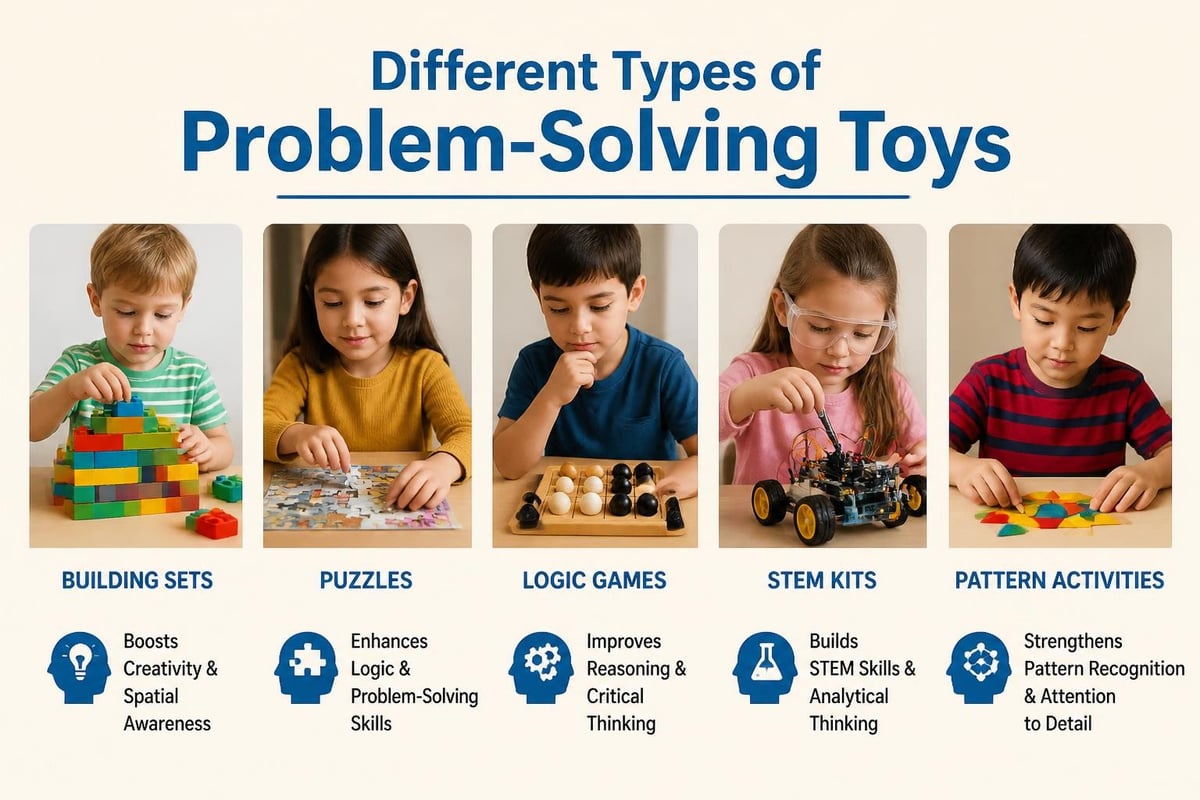
Different toy categories target specific cognitive skills. Understanding these differences helps parents select toys that address particular developmental goals.
Building and Construction Sets
Construction toys remain among the most effective tools for developing spatial reasoning and planning skills. Children learn to visualize three-dimensional structures and execute their plans.
Classic wooden blocks teach fundamental engineering principles through play. Children discover balance, symmetry, and structural stability by building and rebuilding different designs.
Modern magnetic construction sets add new dimensions to building play. The magnetic connections allow for creative structures that would be impossible with traditional blocks.
Puzzles and Pattern Games
Puzzles develop patience, visual discrimination, and systematic problem-solving approaches. Children learn to break large challenges into manageable pieces.
- Traditional jigsaw puzzles teach edge-finding strategies and color/pattern matching
- 3D puzzles introduce spatial reasoning and structural thinking
- Logic puzzles develop deductive reasoning skills
- Pattern completion games strengthen sequential thinking
- Tangrams and geometric puzzles teach shape recognition and transformation
STEM and Engineering Toys
Science, technology, engineering, and mathematics toys make abstract concepts concrete through hands-on exploration. These toys for problem solving prepare children for increasingly technology-focused futures.
Simple machines and gear sets teach mechanical principles. Children see immediate results from their experiments, reinforcing cause-and-effect understanding.
Coding toys introduce computational thinking without screens. These toys use physical pieces to teach sequencing, loops, and conditional logic.
Open-Ended Creative Materials
Materials without predetermined outcomes encourage children to define their own problems and solutions. This type of play builds creative confidence and innovation skills.
Modeling clay and building materials allow unlimited experimentation. Children learn that problems can have multiple valid solutions.
Art supplies combined with building challenges create opportunities for aesthetic problem-solving. Children balance functional requirements with creative expression.
Choosing the Right Problem-Solving Toys for Your Child
Several factors influence which toys will best support your child's development. Consider these elements when making purchasing decisions.
Interest-Based Selection
Children engage more deeply with topics that naturally interest them. A child fascinated by vehicles will solve more complex challenges with transportation-themed toys than with generic puzzles.
Observe what captures your child's attention during free play. These interests indicate which problem-solving toys will maintain engagement long enough for meaningful learning.
Developmental Readiness Indicators
- Attention span length suggests appropriate puzzle complexity
- Frustration tolerance indicates suitable challenge levels
- Fine motor control determines manipulation requirements
- Previous experience with similar toys affects starting difficulty
- Independent play ability suggests how much guidance they'll need
Quality Over Quantity Approach
A few well-chosen toys for problem solving provide more developmental value than dozens of mediocre options. Quality toys withstand repeated use and grow with children.
Look for toys made from durable materials that will survive enthusiastic play. Wooden toys and high-quality plastics often outlast cheaper alternatives by years.
| Feature | Why It Matters | What to Look For |
|---|---|---|
| Durability | Withstands repeated use | Solid construction, quality materials |
| Safety | Protects children during play | Non-toxic materials, no small parts for young children |
| Age Appropriateness | Matches developmental level | Clear age recommendations, adjustable difficulty |
| Open-Ended Design | Grows with the child | Multiple ways to play, no single solution |
| Educational Value | Teaches specific skills | Clear learning objectives, progressive challenges |
Integrating Problem-Solving Play into Daily Routines
Consistent exposure to challenging play experiences accelerates skill development. Creating regular opportunities for problem-solving doesn't require major schedule changes.
Creating a Problem-Solving Play Space
Designate an area where children can leave complex projects in progress. This dedicated space signals that problem-solving is valued and important.
Organize toys by type rather than dumping everything together. When children can easily find specific materials, they're more likely to engage with challenging activities.
Balancing Guided and Independent Play
Children need both adult support and solo exploration time. The right balance depends on individual temperament and experience levels.
- Introduce new toys together to demonstrate basic concepts
- Step back once fundamentals are understood to allow independent exploration
- Remain available for consultation without hovering
- Celebrate problem-solving efforts regardless of outcomes
- Ask open-ended questions that prompt deeper thinking
Screen-Free Problem-Solving Alternatives
Physical toys for problem solving offer developmental benefits that digital games cannot replicate. Tactile experiences engage different neural pathways than screen-based activities.
Screen-free play ideas encourage children to use their whole bodies while thinking, strengthening the mind-body connection essential for holistic development.
Montessori Principles in Problem-Solving Toy Selection
Montessori education emphasizes self-directed learning through carefully designed materials. These principles translate perfectly to choosing effective problem-solving toys.
Child-Led Exploration
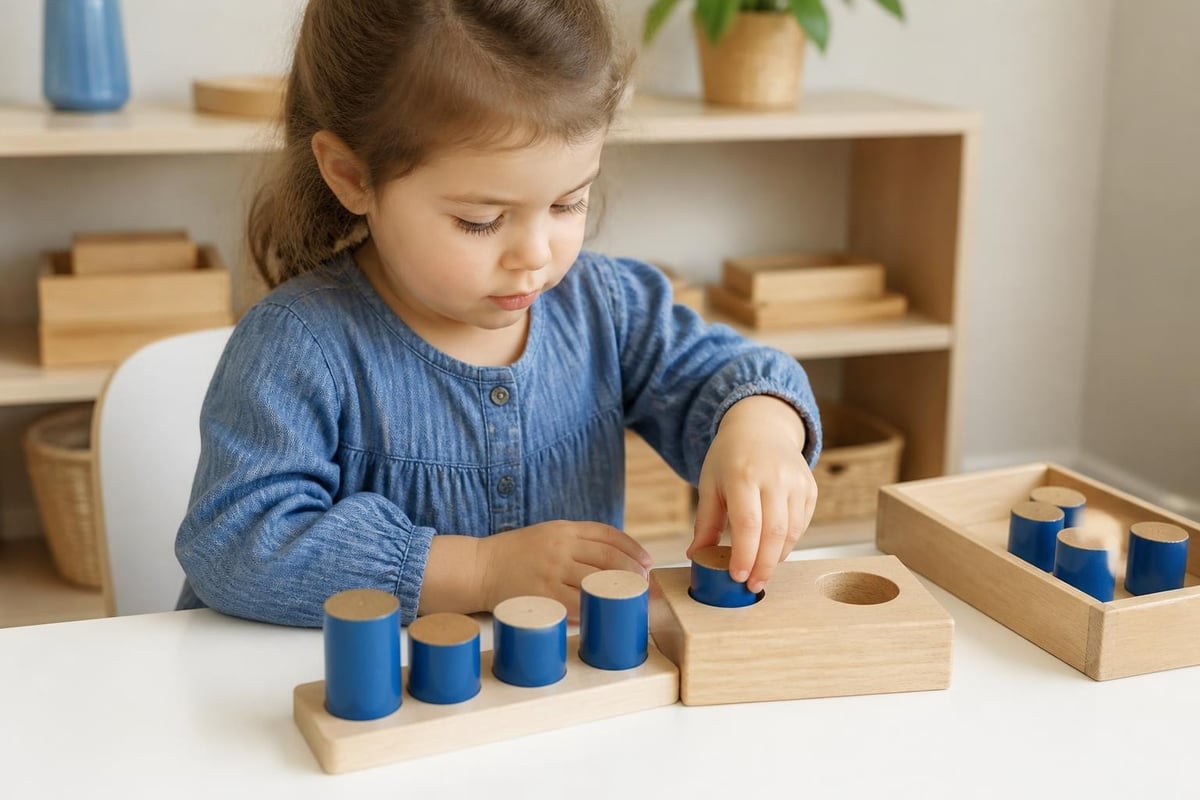
Montessori toys allow children to discover solutions independently rather than being told answers. This approach builds confidence and intrinsic motivation.
The best toys for problem solving present challenges at the edge of a child's current abilities. This "just right" difficulty level keeps children engaged without causing overwhelming frustration.
Real-World Connections
Toys that mimic real-life objects help children understand how problem-solving applies beyond playtime. Life-skill toys like locks, latches, and fasteners teach practical abilities.
Montessori-inspired toys focus on natural materials and realistic designs that prepare children for actual challenges they'll face.
Natural Consequences and Error Correction
Quality problem-solving toys provide immediate feedback. When a puzzle piece doesn't fit, children know instantly without adult intervention.
- Self-correcting design shows children when solutions are incorrect
- Natural consequences teach cause and effect
- Visual feedback confirms successful problem-solving
- Physical resistance indicates wrong approaches
- Satisfying completion reinforces correct solutions
Supporting Your Child's Problem-Solving Journey
Parental involvement significantly impacts how much children gain from their toys. The way adults respond to struggles shapes children's attitudes toward challenges.
Encouraging Productive Struggle
Allow children to wrestle with problems before offering help. This productive struggle builds resilience and problem-solving stamina.
Resist the urge to immediately fix things when children get stuck. Instead, ask questions that guide them toward solutions they discover themselves.
Asking the Right Questions
- "What have you tried so far?" validates efforts and encourages reflection
- "What else could you try?" prompts creative thinking
- "How did you figure that out?" reinforces successful strategies
- "What would happen if...?" encourages prediction and hypothesis testing
- "Can you show me your thinking?" makes cognitive processes visible
Celebrating Effort Over Outcomes
Praise the problem-solving process rather than just successful completion. This approach teaches children that struggle and failure are valuable parts of learning.
Notice specific strategies: "You kept trying different ways until one worked!" This specific feedback helps children understand exactly what behaviors to repeat.
Common Mistakes to Avoid When Choosing Problem-Solving Toys
Even well-intentioned parents sometimes select toys that don't deliver expected developmental benefits. Awareness of common pitfalls improves purchasing decisions.
Choosing Toys That Are Too Advanced
When toys exceed a child's developmental level, frustration replaces engagement. Children abandon overly difficult toys instead of developing problem-solving skills.
Watch for signs that a toy is too challenging: immediate frustration, lack of independent engagement, or complete disinterest. These signals suggest waiting a few months before reintroducing the toy.
Selecting Only Single-Solution Toys
Toys with one correct answer limit creative problem-solving. While these toys have value, balance them with open-ended materials that encourage multiple solution paths.
Doing Too Much for Children
When adults solve problems for children, they steal valuable learning opportunities. Children need to experience the full problem-solving cycle, including mistakes and corrections.
- Avoid completing puzzles when children step away briefly
- Resist fixing structures that collapse during building
- Don't point out exactly where puzzle pieces go
- Let children discover why their approach isn't working
- Wait to be asked before offering assistance
The Long-Term Benefits of Problem-Solving Play
Skills developed through toys for problem solving extend far beyond childhood. These abilities form foundations for academic achievement and career success.
Academic Advantages
Children experienced with problem-solving toys often excel in mathematics and science. They approach abstract concepts with confidence developed through concrete play experiences.
Reading comprehension also benefits from problem-solving skills. Understanding complex narratives requires the same analytical thinking developed through challenging toys.
Life Skills Development
Problem-solving toys teach persistence that transfers to all areas of life. Children learn that effort and strategy overcome obstacles.
Social problem-solving also improves. Children who regularly work through toy-based challenges apply similar thinking to peer conflicts and social navigation.
Preparing for Future Success
The rapidly changing job market requires adaptability and creative problem-solving. Toys designed for cognitive development prepare children for careers that don't yet exist.
Innovation requires comfort with uncertainty and willingness to experiment. These attitudes develop naturally through problem-solving play during early childhood.
Building a Balanced Toy Collection
A well-rounded collection includes various problem-solving toy types that target different skills. This variety ensures comprehensive cognitive development.
Essential Categories to Include
Every child benefits from having access to construction toys, puzzles, logic games, and open-ended creative materials. These core categories address different aspects of problem-solving.
- Basic building blocks for foundational spatial reasoning
- Age-appropriate puzzles that progressively increase in difficulty
- Simple machines or gear toys that demonstrate mechanical principles
- Pattern and sequencing games for mathematical thinking
- Open-ended art and craft materials for creative problem-solving
Rotating Toys to Maintain Interest
Instead of overwhelming children with choices, rotate toys every few weeks. This strategy makes old toys feel new again while reducing clutter.
Store half the toy collection out of sight. When children seem bored with available options, swap out toys for fresh challenges. This rotation also helps you observe which problem-solving toys generate the most engagement.
Investing in Growth-Oriented Toys
Some toys for problem solving remain engaging across multiple years because they offer adjustable difficulty. These versatile toys provide better long-term value than age-specific options.
Building sets with expansion packs grow alongside children's abilities. As skills develop, additional pieces create new challenges without requiring entirely new toys.
Problem-solving skills developed through engaging play experiences shape how children approach challenges throughout their lives. By selecting toys that match developmental stages, encouraging productive struggle, and celebrating effort over outcomes, you create learning opportunities that feel like pure fun. KIDZEEHUB offers carefully curated Montessori-inspired and educational toys designed to build critical thinking, creativity, and confidence through screen-free play. Explore our collection today to find the perfect problem-solving toys that will grow with your child and make learning an adventure they'll love.


